9 Essentials for a Special Education Classroom That Actually Functions Well
Your classroom can have great people, great intentions, and numerous resources, and still be ineffective.
This happens when too much of the day relies on your memory or improvisation. If one transition runs long, one student gets stuck, or one service block gets interrupted, everything suddenly begins to fall apart.
You don't need to have the neatest classroom to make it the most functional. You just need to keep things working under real SPED conditions. Here are nine essentials that can make that possible.
1. A Classroom Layout That Tells Students What to Do
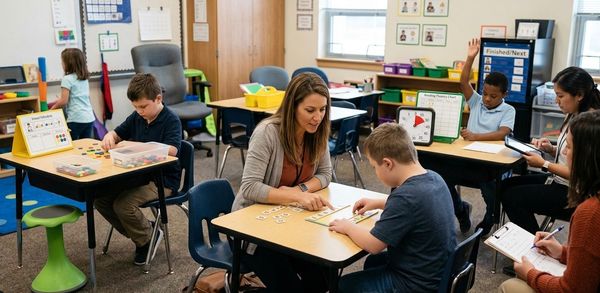
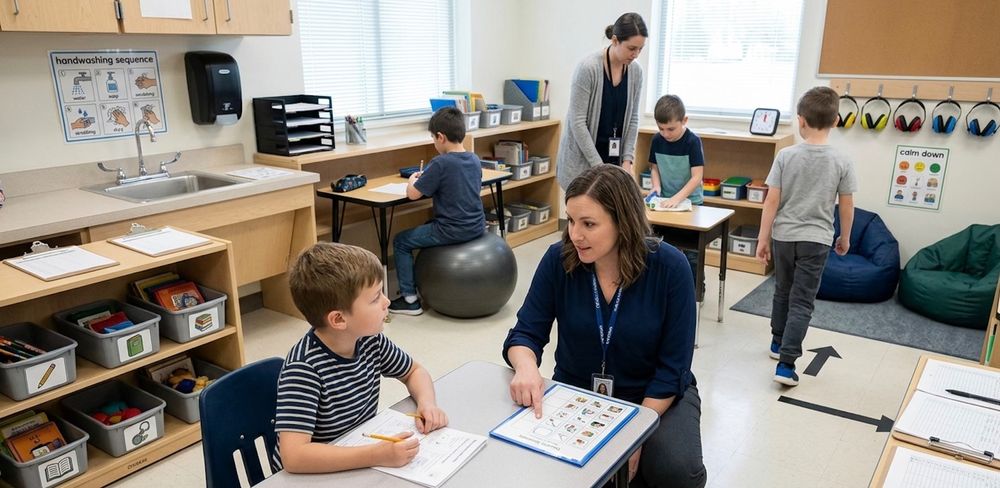
Define spaces by zones. A table can never be used for direct instruction, breaks, make-up work and speech pull-in support all at the same time. If you have to use it for all of these (and more), your kids will need to be constantly redirected.
Teach the room. Once you have designated the spaces in your room, use the same seating, materials, etc., long enough for kids to understand what those spaces mean.
Reduce Visual & Physical Distractions. Move high-distraction material away from the tables. Keep supplies that are used often close to where they're being used.
Check Access For Service Providers. See if there are any accessibility issues that OTs and PTs might be facing. You need to determine if the movement paths, seating, and equipment access are actually workable for them.
2. Visual Supports Placed at the Point of Need
Simply "Adding more visuals" means cluttering your classroom. Instead, match each visual to a specific task. For example, you should have a handwashing sequence placed near the sinks, not hanging on the other side of the room. A first-then board should be offered at places where tasks usually start. Put a choice board only where choices really are being provided. Place a coping menu in those spots where students can actually see it before escalating.
Also, consider reducing the amount of visual stimuli. Too many posters, icons, reminders or colour-coded systems can make good visual aids difficult to locate.
3. Routines That Cut Down on Adult Narration
Identify 5-7 routines that cause the most drag daily and tackle those first. Whether it is small group transitions, independent work starts, cleaning up, or returning materials after the session ends, teach the routine as you would teach other repeated academic skills. Model them. Practice them. Prompt students on how they should proceed next. Repeat this cycle until the student can independently perform the routine.
Use brief language each time the routine happens. Do not vary the language too frequently. Incorporate a visible endpoint so students can know when a routine is completed. If a transition consistently fails, you might want to reduce the waiting time, the total number of steps involved, or assign a concrete first action.
4. Materials That Remove Barriers Instead of Adding Them
A. Keep daily supplies of instructional materials readily available at all times so students don’t have to wait. Unsharpened pencils, half-charged AAC devices or missing visuals and datasheets can easily kill your lesson’s momentum.
B. Find the right materials. If you want written output from students, they may require resources like lined visuals, sentence frames, grips, slant boards, keyboard access, etc. However, if you simply want them to complete a task, then a visual checklist would likely serve them better than yet another verbal cue.
C. Organise the materials so they can be used independently. While not all items need to be placed within easy reach of a student, many items can be. A student does not need an adult's approval to take a pencil, hand in completed work or grab a taught support.
D. Eliminate unnecessary clutter that does not add value to the learning environment. Multiple baskets, bins, fidgets or manipulatives create significant clean-up challenges. Remove the materials that do not solve real issues.
5. Clear Adult Roles During Instruction
Assign roles by blocks (not just job titles).
- Determine which adult will instruct and which adult will provide support, so students do not have multiple individuals directing their attention simultaneously.
- An adult collecting student responses shouldn't be prompting the students as well. Otherwise, the data becomes unmanageable quickly.
- Consider how adults will assist with transitions and services. When providing push-in service, determine which adult will adjust tasks while other professionals (SLPs, OTs, PTs) work on targeted goals. When transitions happen, decide who will monitor students who may fall behind.
6. Instruction Built Around Attention, Not Just the Timetable
Some teachers assume all 20-minute blocks take an equivalent amount of effort from the student.
They don't. Copying information from the board, writing a paragraph, transitioning after completing a preferred task, and following oral instructions that involve multiple steps all draw on separate skillsets. When schools fail to recognise this, students appear inattentive or defiant. The truth is, they're just overworked.
To plan your sessions right, place the most demanding task at the beginning of the instructional block. Divide larger tasks into smaller chunks. Alternate between demanding, high-output tasks and short response formats. Use timers judiciously, but provide students with a clear stopping point rather than simply adding additional time pressure.
7. A Response Plan for Dysregulation That Staff Can Actually Follow
A. Identify early warning signs: Determine what adults need to observe first so intervention can be provided before further escalation happens.
B. Outline adult response: Clearly define the first actions an adult should take. Specify which demands to drop immediately and how to offer space.
C. Protect other students in the room: Determine who will support other students while another adult is responding to the dysregulated student.
D. Clearly Define Re-Entry: Write out what re-entry will look like once escalation has been addressed. It should be calm, specific and must not depend on your improvisation.
8. Independence That Is Taught, Not Assumed
Distinguish between the supports the student really needs and those that he/she has just become accustomed to receiving.
If the student waits for a verbal prompt before beginning each and every task, replace it with a visual cue, a pre-taught start routine, or a single check-in after the first minute.
If a student routinely asks about where to place completed assignments, this could be due to environmental design issues.
Identify one independence goal at a time. Clearly teach that skill. Reduce prompting over time, but do not eliminate all assistance at once to label that as "independence". Your students need a bridge, not a cliff.
9. Documentation That Helps the Classroom Run Better
Spend your time collecting data that you'll need to answer the following questions:
A. How much is your student improving?
B. Are they using the accommodations provided?
C. Is the service happening as planned?
D. Does their performance vary based on the type of task, setting, or time of day?
You don't need to develop some elaborate system that falls apart after a week. All you need is an easy-to-use data tracking tool that lets you log data consistently.
Many educators now use AbleSpace or similar tools to keep services, accommodations, progress notes, and team documentation connected in one place. Since such apps can also be used on phones and iPads, staff can log data as they go and generate graphs and progress reports from the same data!
When documentation mirrors everything that happened, the classroom becomes easier to adjust, support, and trust. That is what a functioning room comes down to.