How to Balance Teaching and Data Collection in Real Time
Special education classrooms often exist on two parallel timelines. One is visible: the lesson, the prompts, the student working through a task. The other runs alongside it: timestamps, tallies, progress markers that later represent what happened in that session. The challenge isn’t just time. It’s where your attention sits when both demand it at once.
The teachers who can avoid this aren’t doing more. They’ve just altered the way these two timelines intersect so one doesn’t keep intruding on the other.
You can do it too.
This blog explores how to bring data into your teaching without disrupting it, through lesson design, in-the-moment decisions, and practical tracking systems.
Accuracy vs. Presence: Letting Go of Perfect Data
The quest for accurate data can get in the way of instruction. When you have to capture every response, attention turns away from the student and onto the system.
Remember, stability weighs more than perfection. Data collected consistently, if somewhat less comprehensively, often show clearer trends than extremely detailed but rarely taken records. Tracking too much data at a time can also distract you away from the student at the wrong time.One doesn’t have to capture everything. As long as they capture enough reliably without breaking the flow of the session, it’s a win.
Designing Lessons That Carry the Data
Things get easier when you integrate data collection into the lesson structure itself.
Instead of asking, “When do I record this?”, ask, “Where in this lesson will responses naturally occur?”
Here’s what you can do.
- Integrate predictable checkpoints into the activities, times where responses are anticipated and easy to monitor
- Use task formats that generate crisp results (independent vs. prompted, correct vs. incorrect)
- To go a step further, you can align tasks closely with IEP goals. That’s how you can avoid having to interpret or translate responses after the fact.
Adopting these simple habits allows data to stop interrupting instruction. Instead, it can settle naturally within it.
Designing Lessons That Carry the Data
Things get easier when you integrate data collection into the lesson structure itself.
Instead of asking, “When do I record this?”, ask, “Where in this lesson will responses naturally occur?”
Here’s what you can do.
- Integrate predictable checkpoints into the activities, times where responses are anticipated and easy to monitor
- Use task formats that generate crisp results (independent vs. prompted, correct vs. incorrect)
- To go a step further, you can align tasks closely with IEP goals. That’s how you can avoid having to interpret or translate responses after the fact.
Adopting these simple habits allows data to stop interrupting instruction. Instead, it can settle naturally within it.
Focusing Your Attention
Attempting to watch over too many objectives at once isn’t a wise move. The result is patchy data that’s hard to act on.
Narrowing context sharpens both instruction and monitoring.
- Focus on one or two goals at a time to collect data purposefully and intentionally.
- Rotate secondary goals across the week. Trying to do them all every day will inevitably burn you out.
- Spend enough time on selected targets to see meaningful patterns, not just isolated responses.
Prioritising doesn’t mean you’re neglecting other goals. You’re just giving each one the attention it needs rather than spreading attention too thin.
Capturing Without Disrupting the Interaction
Recording can interrupt the flow of a session. A break to write, even for just a minute or two, can redirect focus away from the student while something important is happening.
Here’s how you can collect data more thoughtfully.
- Make brief mental notes and record them during natural breaks. Such breaks can include transitions, material changes, or even short pauses during the session.
- Consider using shorthand or simple codes that reduce writing time to merely a few seconds.
- You can also record a set of responses together instead of marking each one separately.
That’s how experienced educators preserve continuity. Instruction flows, and data still gets captured without compromising on student engagement.
When the System Starts Working Against You
More often than not, the structure of data collection can itself become the problem.
Unfinished records, delayed entries, and a sense that tracking is always slightly behind don’t mean you’re putting in any less effort. If you experience these frequently, it just means your system is asking too much from you.
- If data is consistently incomplete, the method may be too complex for real-time use.
- If student engagement drops when you record, the timing or visibility of data collection might be the real issue.
- Also, some sessions, particularly those rooted in regulation, rapport building, or new environments, may not require formal tracking at all. Not all progress is readily measurable. It’s okay to be flexible in such instances.
Building Systems You Don’t Have to Think About
One invisible challenge that educators face while collecting session data is decision fatigue. Each time you pause to figure out how to record something, attention gets pulled away from the classroom.
Use consistent formats, tools and symbols across students. Prepare materials in advance so nothing needs to be set up mid-session. Keep your system simple enough so it can run on habit.
That’s how you can make data-tracking feel automatic over time.
Want a bonus tip?
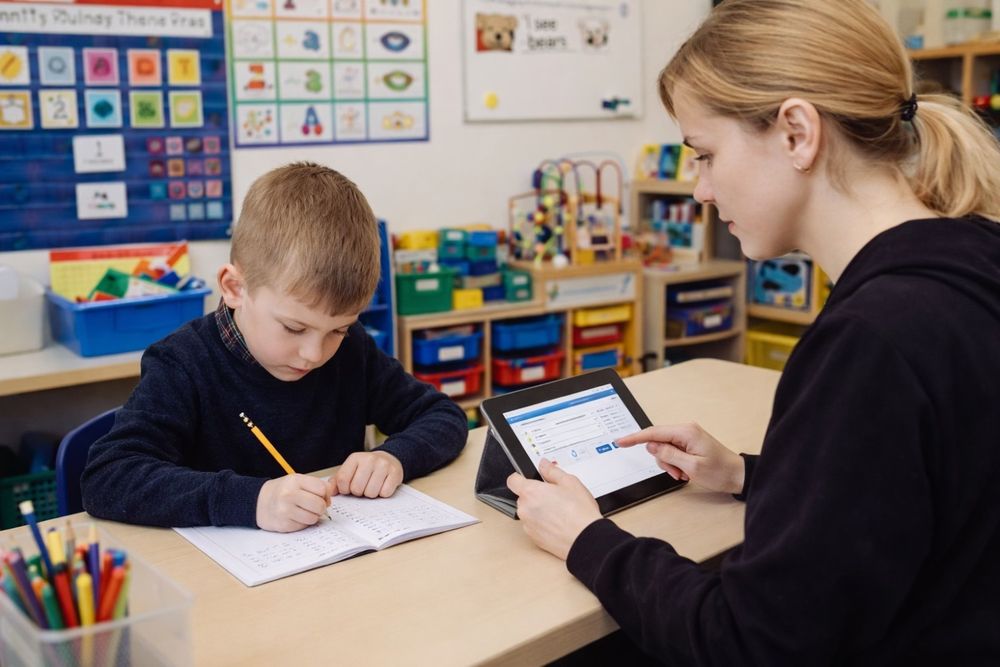
AbleSpace and other similar data-collection apps go a long way in helping educators remove the small decisions that add up during a session.
Responses can be logged in one tap using pre-set data types such as accuracy, frequency, or duration, while service time and attendance are recorded as part of the session itself. In fact, users can also generate graphs and IEP reports directly from the data points that they log. If you wish to level up your data collection game, tools like these are always worth checking out.
Conclusion: Bringing It Together After the Session
What happens in the few minutes after a session often decides whether the work you just did will carry forward with clarity or simply fade away. Once the session ends, don’t forget to:
- Fill in anything partial while the details are still fresh.
- Add a line of context where a response might otherwise feel unclear later.
- Make sure what’s recorded reflects the session as it actually happened.
It’s an easy step to skip, particularly on busy days. But this is often where haphazard observations turn into something vital, something you can return to, trust, and build on without starting over.