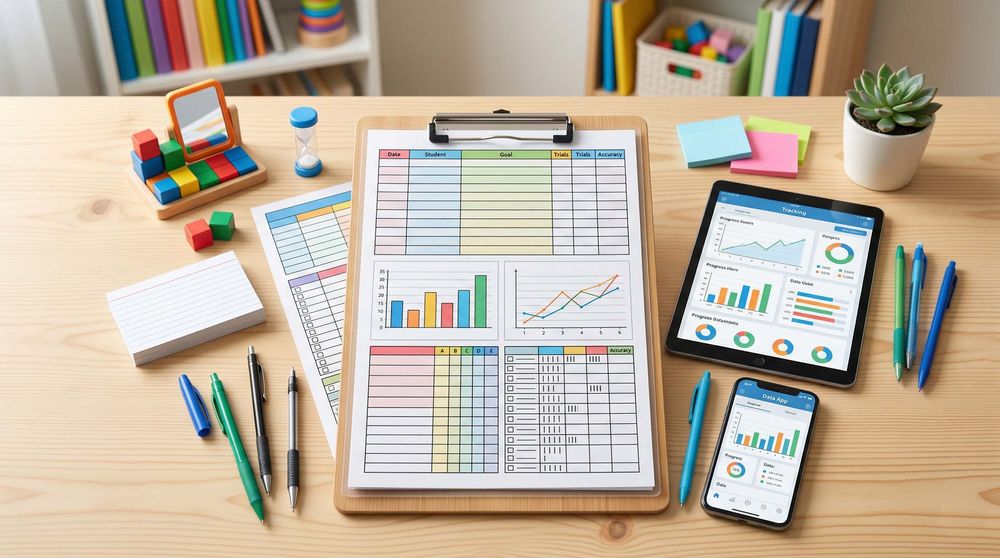
How to Track Speech Therapy Data: Free Sheets, Examples, and Digital Tools
You finish a session, and then the real work begins. Writing notes, calculating percentages, and organizing data. It’s exhausting and easy to fall behind.
But data collection in speech therapy is what helps you convert those individual sessions into tangible, measurable progress. It involves documenting a student's performance during therapy to demonstrate their growth towards specific goals established in their Individualised Education Program (IEP).
Examples of data collected may include:
- Accuracy of responses by the student (i.e., correct/incorrect).
- The number of trials the student completes.
- The level of prompting used with the student.
- Notes regarding the student's behaviour and/or communication patterns.
SLPs utilise this data to:
- Track students' progress toward IEP objectives.
- Make decisions for future therapy interventions.Support documentation for reports and compliance.
Types of Speech Therapy Data You Should Track
In order to assess student progress, you must collect data based on the specific skill(s) your students are working on. The primary types of data that SLPs collect include:-
Speech Articulation Data - This type of data is collected to determine whether or not a student correctly produces speech sounds. It can include the number of correct responses, sound positions, and the amount of prompting the student requires to produce the correct sound.
Expressive Language Data - This type of data is used to determine how easily a student can express ideas. It includes sentence structure, vocabulary, and answering questions.
Receptive Language Data - This data is used to determine if the student has a good understanding of language. It involves following multi-step directions and comprehension skills.
Fluency Data - This type of data is used to determine the ease with which a student speaks (speech smoothness). It includes types of disfluencies and the use of fluency strategies.
Pragmatics (Social Communication)- This sort of data is concerned with the social use of language. It encompasses conversation skills, turn-taking and topic maintenance.
Free Data Collection Sheets
If you need a pre-made speech therapy data collection sheet or an SLP data collection template that allows for flexibility while collecting data for IEP progress tracking, you’ll find many free resources created by experienced SLPs. Below are some different types of templates you can use for speech therapy data tracking, when each one is useful, and examples.
1. Trial-Based Data Sheet
Free articulation data sheet by Communication Community
These sheets will let you track responses across multiple trials in a structured manner. [Download here→]
When to use it
You can try it out when you need precise accuracy data for articulation or structured goals. It works best for drill-based sessions where you are collecting multiple responses quickly.
Example (Filled)
Target: /s/ sound (initial position)
Trials: 10
Correct: 8
Accuracy: 80%
2. Percentage Tracking Sheet
Free speech therapy data sheets from Allison Fors
These templates focus on overall percentages instead of individual trials, making them faster to use for speech therapy progress tracking. [Download here→]
When to use it
Use this for quick speech therapy progress tracking when you won’t really require trial-by-trial data but would still like having measurable outcomes for reports.
Example (Filled)
Goal: Answer WH questions
Session Accuracy: 4/5
Percentage: 80%
3. Prompt Level Tracking Sheet
Cue-based data sheets from various SLP creators
These sheets track how much support a student needs, not just correctness. Many also include cue levels and independence tracking.
You can find similar examples from Speech Therapy Store: [Download here→]
When to use it
Use this for goals where independence matters (such as language or pragmatics). This type of SLP data collection template is especially useful for detailed IEP data tracking speech therapy.
Example (Filled)
Task: Describe the picture
Independent: 2/5
With prompts: 5/5
Prompt type: Verbal + gestural
4. Session Notes + Data Hybrid Sheet
Free printable and digital sheets from Busy Bee Speech
These combine a speech therapy data collection sheet with session notes, which makes them useful for both tracking and documentation. [Download here→]
When to use it
Use this when you want all your data in one place. It’s ideal for busy SLPs who manage multiple students and sessions all the time.
Example (Filled)
Goal: Use 3-word phrases
Accuracy: 70%
Notes: Needed visual cues, improved with modeling
These templates are great starting points. But as your caseload grows, managing multiple sheets, calculating percentages, and organising data can quickly become pretty overwhelming.
That’s where digital tools can simplify your entire speech therapy progress tracking system.
How to Track Data Faster
You don't have to let tracking data impede your sessions. The key is to have a system that simplifies your speech therapy progress tracking while collecting accurate, relevant data.
A. Focus on One Goal at a Time - Tracking too many things simultaneously will lead to messy and unorganised data. Choose just one goal for each activity. Use a simple speech therapy data collection sheet that improves speed and keeps you focused.
B. Use Simple Marking Systems - Instead of documenting all the details or writing out full notes during the trial, use quick symbols:
✓ for correct
✗ for incorrect
P for prompted
That's how your SLP data collection template becomes faster to use in real time.
C. Collect data in real-time - Do not rely solely upon your memory after the session. Document the student's response as it happens to keep your speech therapy data consistent and accurate.
D. Batch Your Calculations - Don’t calculate percentages after every trial. Complete your session first. You can then quickly total your data. This keeps your workflow more efficient.
E. Be consistent with your system - Changing from one format to another may cause frustration and slow you down. Use a consistent format and structure, so your speech therapy data collection sheet becomes second-nature.
F. Consider Digital Tracking - While paper-based methods are fine, they tend to become increasingly difficult to maintain as your caseload grows. They involve managing multiple sheets of paper, calculating by hand, and storing loose documentation, all of which can disrupt your entire workflow.
Tools like AbleSpace make this a lot simpler. Instead of entirely depending on a paper speech therapy data collection sheet or an SLP data collection template, you can:
- Track your data in real time during sessions.
- Automatically calculate accuracy and percentages.
- Align data directly with the IEP goals.
- Generate reports without any extra manual work.
AbleSpace also includes built-in data collection sheets. You can generate customized sheets for selected students and different goal types. If you still like paper better, you can even download them as a document or print them directly to continue your workflow without disruption!
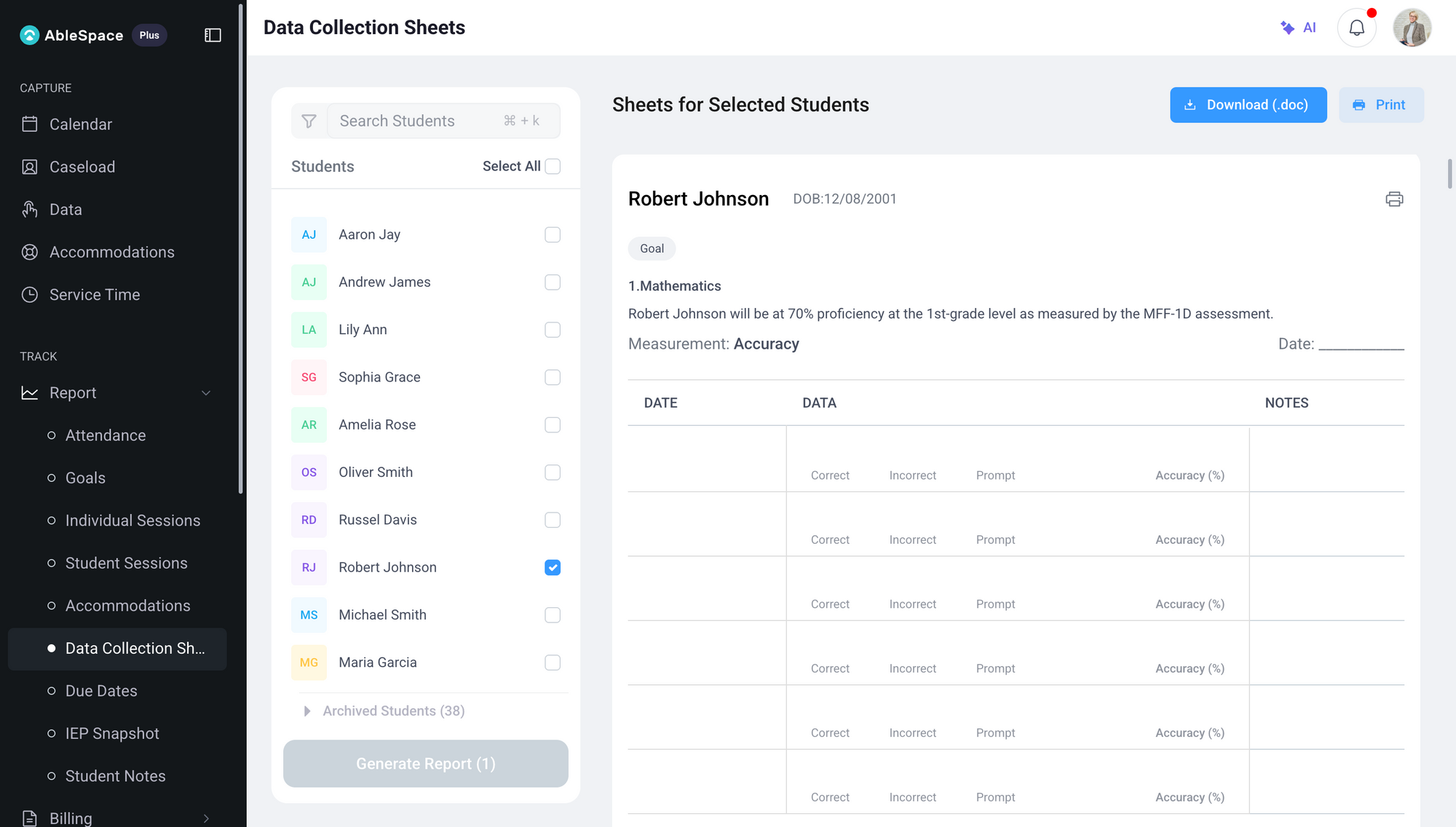
This gives you the flexibility of paper with the efficiency of digital, thus making your speech therapy progress tracking quicker/more organized than ever.
After all, the faster your system, the more time you get back for what actually matters. Therapy.
Speech Therapy Data Collection Examples
Here are a few real examples that show how a speech therapy data collection sheet or SLP data collection template is used in practice for effective speech therapy progress tracking and IEP data tracking.
Articulation Example
Goal: Produce /s/ in initial position with 80% accuracy
Data: 8/10 correct
Prompt Level: Minimal verbal cues
This type of entry is common in a trial-based speech therapy data collection sheet.
Expressive Language Example
Goal: Answer WH-questions with 80% accuracy
Data: 4/5 correct (80%)
Notes: Needed visual cues for “why” questions.
This works well in a percentage-based SLP data collection template.
Receptive Language Example
Goal: Follow 2-step directions
Data: 3/5 independent, 5/5 with prompts
Notes: Improved with repetition
Useful for IEP data tracking speech therapy, where independence matters.
Fluency Example
Goal: Use fluency strategies in structured tasks
Data: 4/5 opportunities
Notes: Used a slow rate and paused effectively.
Supports consistent speech therapy progress tracking over sessions.
Pragmatics Example
Goal: Initiate conversation with peers
Data: 3/4 opportunities
Notes: Needed one verbal prompt
Often tracked using hybrid notes + data speech therapy data collection sheets.
Using clear, consistent entries similar to these will make your speech therapy progress tracking easier, more accurate, and aligned with your IEP goals.
Common Mistakes SLPs Make
Even if you have an excellent speech therapy data collection sheet or SLP data collection template, these small errors can turn your data into something less useful than it otherwise would be.
❌ Collecting too much data at once - You'll only end up with an overwhelming amount of inconsistent entries if you try tracking everything in one session. Focus on goal-specific speech therapy progress tracking instead.
❌ Inconsistent Measurement - Using multiple methods and/or criteria makes it almost impossible to compare student progress. Consider using a single method for consistent IEP data tracking and speech therapy.
❌ Not Aligning with IEP Goals - Collecting data that doesn’t directly match the IEP goal makes reporting difficult. So, always tie your data back to measurable outcomes.
❌ Losing Paper Sheets - Paper-based systems can get misplaced or disorganised. This impacts long-term speech therapy and progress tracking.
FAQs
1. What’s the best way to collect speech therapy data?
Try using a consistent speech therapy data collection sheet or a structured SLP data collection template. This ensures accurate speech therapy progress tracking and makes data tracking in speech therapy easier and much more reliable!
2. What should be included in a speech therapy data collection sheet?
A good speech therapy data collection sheet must include trials, accuracy, prompt levels, and session notes. These elements keep your speech therapy progress tracking effective and make sure the data matches with IEP goals.
3. How often should SLPs collect data during sessions?
As an SLP, you should try collecting data consistently during sessions (especially for targeted goals). Real-time, in-the-moment tracking using an SLP data collection template can also boost your data’s reliability and support better data tracking and speech therapy.
4. What is the difference between trial-based and percentage data collection?
Trial-based data tracks each individual response. But percentage data summarizes your student’s overall performance. You can use both methods within a speech therapy data collection sheet (depending on your speech therapy progress tracking needs).
5. How do you track IEP goals in speech therapy?
Seasoned SLPs track IEP goals by collecting measurable data such as accuracy, independence, and prompt levels. You can also start using a structured speech therapy data collection sheet to simplify the reporting part and make sure your speech therapy game stays strong.
6. Are digital tools better than paper data sheets?
Yes! Digital tools can make speech therapy progress tracking faster and much more systematic. They can automate calculations and house all your data in one place. Tools like AbleSpace even allow you to generate and print your own speech therapy data collection sheet or SLP data collection template. You get digital efficiency without having to compromise on the flexibility that paper materials offer.
7. What are some common mistakes made during speech therapy data collection?
Common errors can include tracking too much data, inconsistent measurement, and not aligning with IEP goals. You might want to use clear speech therapy data collection sheets to avoid these headaches and improve IEP data tracking.
8. Can I use free speech therapy data collection sheets?
Yes. In fact, many SLPs use free templates that are available online. These can be a great starting point for speech therapy progress tracking. As long as they align with your goals and support effective IEP data tracking and speech therapy, they’re good to go.